Review: An Illiad at Wharf 1 - Sydney Theatre Company
Review by Kate Gaul
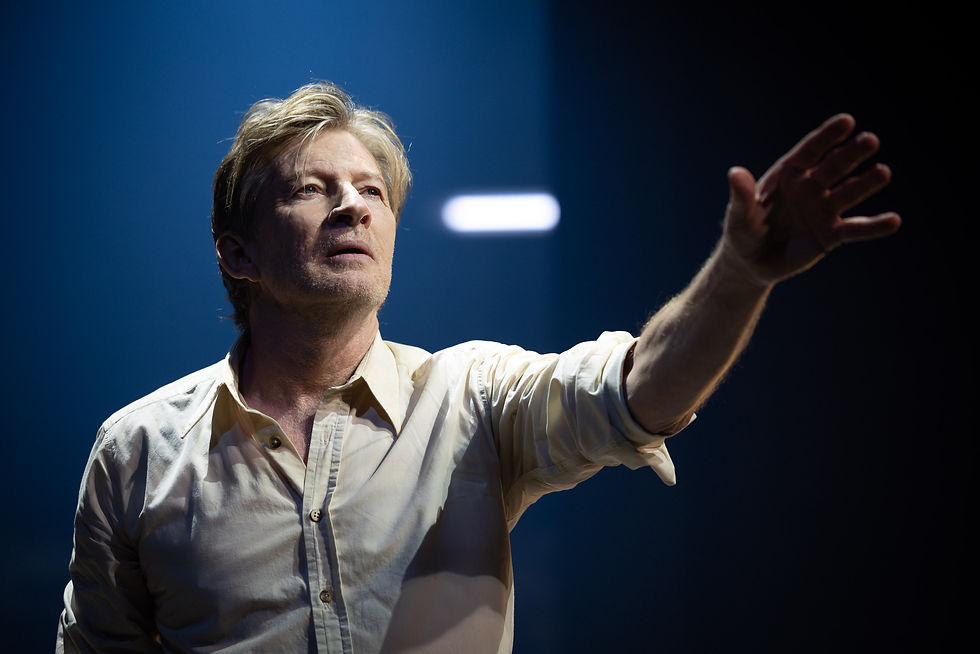
At Sydney Theatre Company’s Wharf 1, David Wenham takes on An Iliad- Lisa Peterson and Denis O’Hare’s one-actor adaptation of The Iliad, directed by Damien Ryan.
The work itself has a formidable lineage. Originally created at Seattle Repertory Theatre, An Iliad distils Homer’s vast epic -over 15,000 lines, composed in Homeric Greek in the 8th century BCE -into a solo performance. The source text, sometimes called the “Song of Ilium,” unfolds during the final weeks of the Trojan War, charting the rupture between Achilles and Agamemnon while spiralling outward to encompass the entire mythic architecture of the siege: its origins, its inevitabilities, its aftermath.
It is, fundamentally, a poem about the recurrence of violence and how war loops through history, retold and relived.
The staging of this production leans into a now-familiar aesthetic of the “found” space: the Poet (David Wenham) enters an already worn, emptied world, dragging behind him a modest cart of belongings from which he extracts objects to stand in for the story’s shifting elements (design Charles Davis). It gestures, perhaps, toward Mother Courage and Her Children - that image of survival through accumulation - but here the metaphor never quite coheres. The objects remain resolutely literal, their symbolic charge underdeveloped. What could accumulate into theatrical poetry instead feels illustrative. The conceit never fully transforms the space; it stays grounded, practical, and ultimately limits the work’s capacity to lift into something more mythic or dangerous.
This adaptation leans heavily on Robert Fagles’ translation, long celebrated for its clarity and accessibility. But “accessible” isn’t the same as alive.
Here, the language sits in an uneasy middle ground: neither fully contemporary nor truly epic. What should surge instead settles. Fagles’ text, in this framing, becomes flattened - intelligible, certainly, but rhythmically inert. The poetry lands as narrative rather than incantation; information rather than invocation.
And Wenham, though an actor of considerable intelligence, leans into that mode. The delivery is controlled to the point of uniformity: a measured recitation that rarely breaks open. The great engine of the story: rage, grief, terror, absurdity - demands volatility, but the tonal range feels compressed. There are too few ruptures, too few moments where the performer seems overtaken by the telling. Where the Poet is seized by Achilles’ mania or Andromache’s grief, we get modulation rather than transformation.
It remains storytelling, rather than possession.
This is the production’s central paradox: a work about the uncontrollable violence of history rendered in a largely controlled, even-tempered register. It’s a choice.
The adaptation itself contributes to this. By framing the text as conversational and digressive, it trades the muscular propulsion of epic poetry for a looser, anecdotal rhythm (with a generous sprinkling of local references thrown in). The stakes dissipate. We are told a story about war, rather than something that enacts it in the room.
What does cut through is the presence of the musician (Helena Svoboda), whose score threads a necessary unease through the evening - an undercurrent of danger and otherworldliness that the text and performance intermittently lack. Together with sound designer Brady Watkins there is something really muscular brewing here that leans into what cannot be spoken, beginning to match the terror of what is being told.
There’s no question the material remains potent. The Iliad, alongside The Odyssey, is one of the foundational works of Western literature - a brutal meditation on honour, mortality, and the cyclical nature of human conflict. Its architecture is vast, its themes, inexhaustible.
This production is intelligent and lucid, but too often dramatically even. An Iliad should feel barely containable, like history erupting through the body of the performer. Here, it feels carefully held.