Review: Toy Symphony at the Pavilion Performing Arts Centre
Review by Kate Gaul
What a fitting way to launch an in-house production program than with one of the Shire's own. Directed by playwright Michael Gow, Toy Symphony returns home in a production that celebrates both the play's enduring strengths and the growing ambition of the Pavilion's producing vision.
This is my fifth encounter with Toy Symphony since its unforgettable premiere in 2007, and the play has lost none of its capacity to surprise, unsettle and move. One of Gow's most personal works, it sits alongside Away and Once in Royal David's City in its exploration of memory, identity and the lingering effects of childhood experience.
Blending autobiography, fantasy and psychological realism, the play follows playwright Roland Henning as he confronts a profound creative crisis. Struggling with writer's block and increasingly disconnected from those around him, Roland is drawn into an excavation of memory through therapy, revisiting childhood experiences, formative teachers, artistic heroes and the habits that have shaped both his success and his failures.
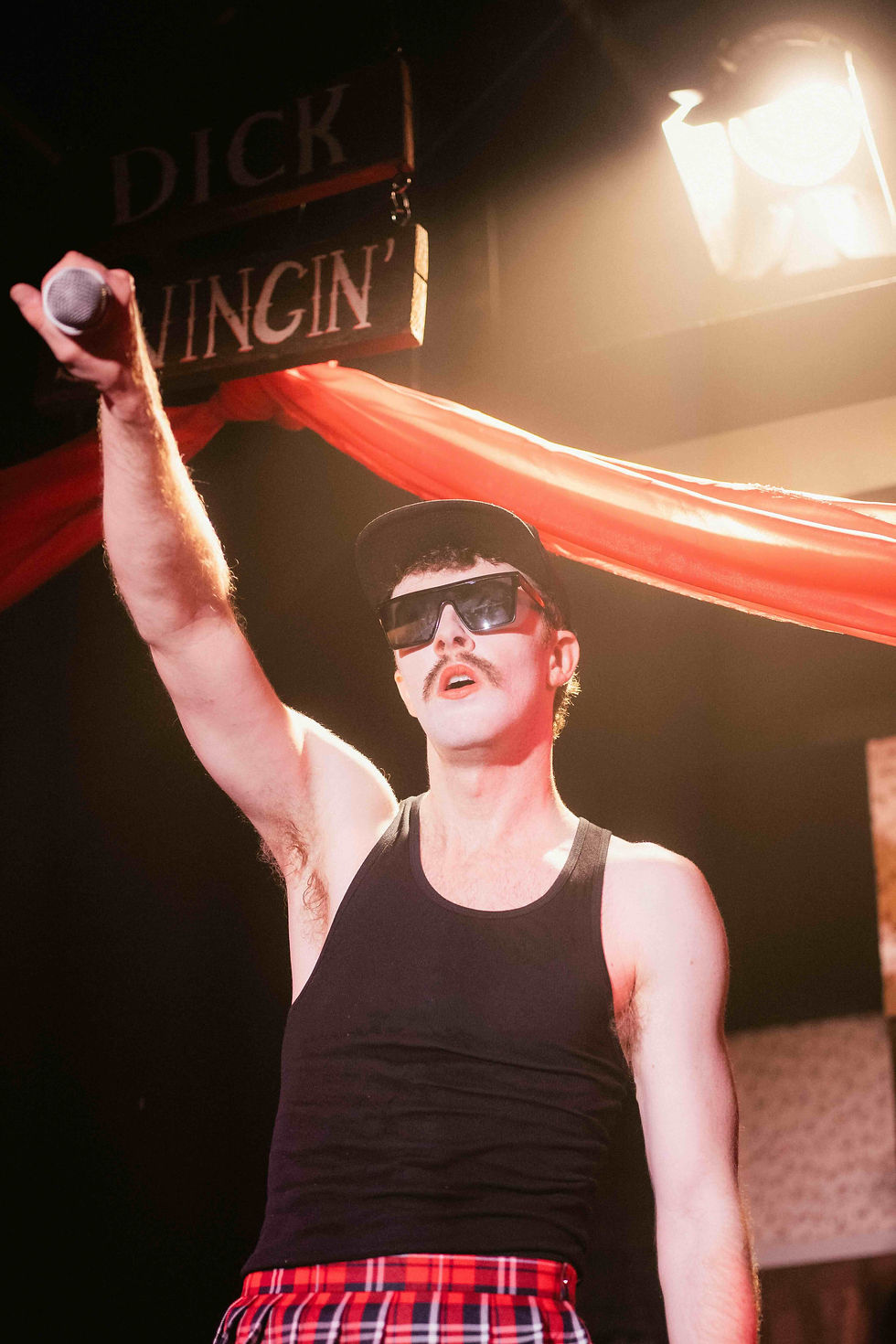
This production draws on local talent (Kane Herbert, Kaitlyn Thor, Alex Baum), ably supported by the experienced presence of Sam O'Sullivan as Roland Henning and Georgina Symes as the unforgettable Miss Walkham. O'Sullivan deftly navigates the contradictions at the centre of Roland: charismatic and vulnerable one moment, selfish and self-destructive the next. Symes brings warmth, wit and quiet authority to a character who looms large in Roland's imagination, embodying the teachers whose influence can echo across a lifetime.
Designer Kate Beere makes a striking contribution. Rather than concealing the mechanics of theatre, Beere opens the magnificent Pavilion stage to reveal fly lines, the grid, upstage walls and backstage doors. Flying objects in and out from the stage and adding simple furnishings to create the various locations of the story. The result is a space that feels simultaneously expansive and intimate, perfectly aligned with the play's meta-theatrical journey through memory and imagination. The theatre itself becomes part of the storytelling, a place where memories are summoned, rehearsed and replayed.
The production's visual atmosphere is beautifully supported by lighting and projection designer Aron Murray. His work creates a succession of evocative environments within the largely open stage picture, allowing memories to emerge and dissolve with elegance and clarity.
Sound designer and composer Johnny Yang - one of the most exciting artists working in independent theatre today - shows remarkable restraint. Rather than competing with the titular “Toy Symphony”, which provides one of the play's emotional touchstones, Yang's score complements and enriches the production, knowing precisely when to speak and when to remain silent. His work comfortably enhances the play’s arc, creating an aural landscape that supports rather than overwhelms the drama.
What remains remarkable about Toy Symphony nearly twenty years after its premiere is its refusal to romanticise the artist. Roland's journey is neither noble nor straightforward. As the play unfolds, Gow offers an unflinching portrait of a man whose creative gifts coexist with dependency, manipulation and emotional recklessness. Figures from Roland's past, alongside literary heroes such as Anton Chekhov, emerge through the play's dreamlike structure, forcing him to confront uncomfortable truths about himself and the stories he tells.
Watching the play again in 2026, I was struck by how much darker it feels than I remember. The second act, in particular, offers a stark portrait of an artist in crisis. Roland's dependence on drugs, his exploitation of those around him and his willingness to sacrifice personal relationships in pursuit of creative renewal are presented without sentimentality. Gow resists easy judgement. The play acknowledges the damage Roland causes while still finding room for compassion, humour and redemption. Under Gow's direction, this production embraces both the shadows and the optimism embedded in the text, inviting audiences to reflect on the messy realities of artistic creation without losing faith in its value.
The Pavilion itself proves a remarkable resource for the region: a theatre capable of hosting work of scale while maintaining a strong connection to its community. If Toy Symphony is an indication of what lies ahead, Sutherland audiences have much to look forward to.
Thoughtful, ambitious and deeply local, this production marks a confident beginning for what one hopes will be a long and fruitful journey of locally produced theatre for curious audiences. In an era when many venues have retreated from producing their own work, the Pavilion's investment in homegrown theatre feels both courageous and necessary.