Review: Fairytalers at the Explosives Factory
Review by Greg Gorton
I am very much a sucker for media that makes me aware of historical figures I had previously never heard of. Figures like Émilie du Châtelet and Harriet Jacobs (forgive my ignorance on both accounts). Now, during the opening of Fringe when I really shouldn’t be reading so much, I have four more names to add to that list. Charlotte-Rose de Caumont de La Force, Henriette-Julie de Murat, Marie-Jeanne L'Héritier de Villandon, and Marie-Catherine Le Jumel de Barneville. These four long-winded women of France played integral roles in the evolution of the modern fairy-tale and I had not heard of a single one. Lucky for me, that Fairytalers exists.
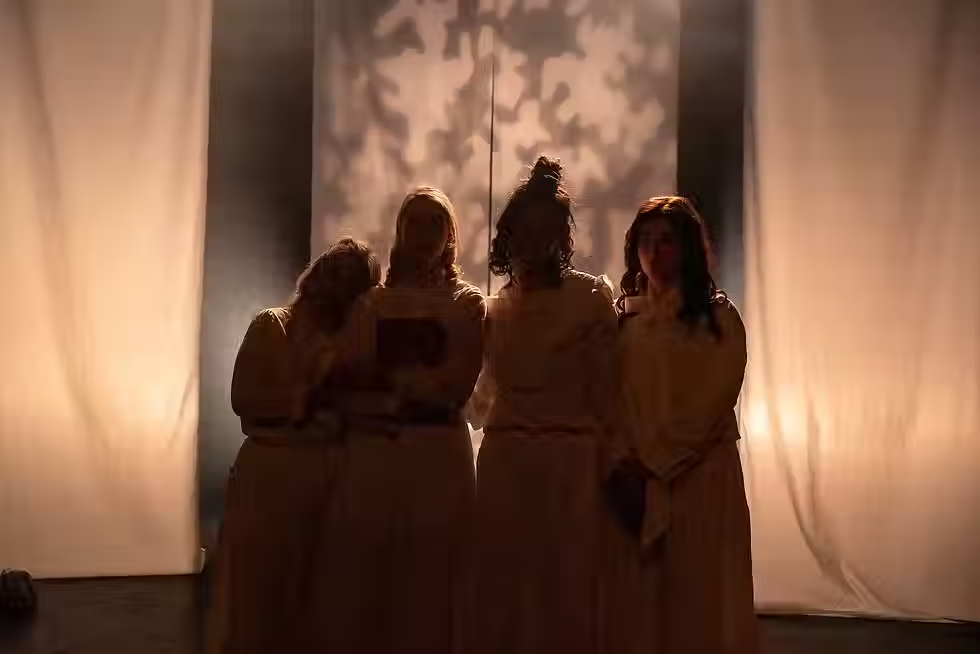
Fairytalers introduces us to four ghosts, who wonder how they have been forgotten. We get to hear their stories - both their fairy tales and their lives. The inevitable arises, that things would have been so much different without the patriarchal world they lived in (and still live in now). But then the show takes us further, pushing us to think about relationships, about legacy, and even about fairy tales, with whole new perspectives.
The set for this play is deceptively intricate. While the papers and suitcases seem strewn around the set, with only the central chest important, time tells just how important each part plays. Lighting and sound are vibrant, with some great choices in music, and clever spotlighting to enhance comedy.
If you had told me that this play would include four readings of fairytales, my knee-jerk reaction would be to say “cut them”. It’s a good thing no one asked me. Away from what could be called the “main play”, are four tales, one from each author, told as their version, and “performed” by the characters (not actors). These performances include shadow puppetry, playing with dolls, and roleplaying. They could easily be performed as little vignettes on their own and stand tall in doing so.
The “main play” (as I begrudgingly call it) is one of heart and laughter. The ghosts know we are there, and some are more excited than others. They, being ghosts not dead, might know all the words to Living La Vida Loca, or be desperate to return to watching reality television. But no, they are having a fight about Wikipedia and we just happen to be there too.
There are moments during the early biographical sections that do get a little bogged down, making sure that each woman has her fair share of trauma vented while their roles as authors become almost neglected. However, there is much ground to cover, and writer Ellis Austin Finnie doesn’t want us to miss out on how rich these lives were that we know so little about.
This is the greatest strength of the production. The characters. Not the stories told about them, though, but the characters as written on page. Finnie has taken what appears to be much research to create four people that I would love to get to know. One might be a little snooty, another too crude, one might have too many romantic notions. Even then, you could not define any of the women presented in this show by a single line. Furthermore, you could give me any single line and I could tell you which of these characters said it - not because I remembered but because they were so much their own women.
While you must give most of the credit here to Finnie, it would not be so clear to me if not for the performances directed by Gabrielle Ward. Daisy Valerio as Charlotte presents someone who wears her heartache on her sleeve, and her snap-breaks between characters is quite shocking when one of them is so quiet and reserved. Olivia Morison’s Henriette made me laugh, yes, but the exploration of her relationship to the women probably pulled my heartstrings more than any other moment. Ellie Carroll’s Catherine is portrayed as the most mysterious life, even if one knows more about it. Carroll captures that elusive spirit, that early trauma and later triumphs, with great aplomb. Grace Gemmell takes the least-known historical figure, and works Finnie’s text into someone so real that I have to assume that a supernatural force ensured its accuracy.
On a bare stage, these women and this text, it would be magical. With a brilliant director, some suitably story-book design choices, and a great score, Fairytalers is a night where edutainment doesn’t sound that dirty a word.