Review: Crepuscular at Motley Wherehaus
Review by Greg Gorton
“Crepuscular”, as Abbey Amber tells us at the beginning of her show, is an adjective describing slightly supernatural moments during the twilight hours, that transition from night and day. It also defines animals that are active during those hours, as well as states of being that fall within a transitional period.
The word fits well with the modern fairy tale that Amber then begins to tell, as well as the world she places her audience into.
Amber is a folk musician and performance artist, and her show is a mixture of poetry, story-telling, and music. The night also includes shadow puppetry, the occasional break into commentary, and some mild audience interaction. For the most, it is a night of quiet reflection, with a layer of tension borne on the back of magic realism.
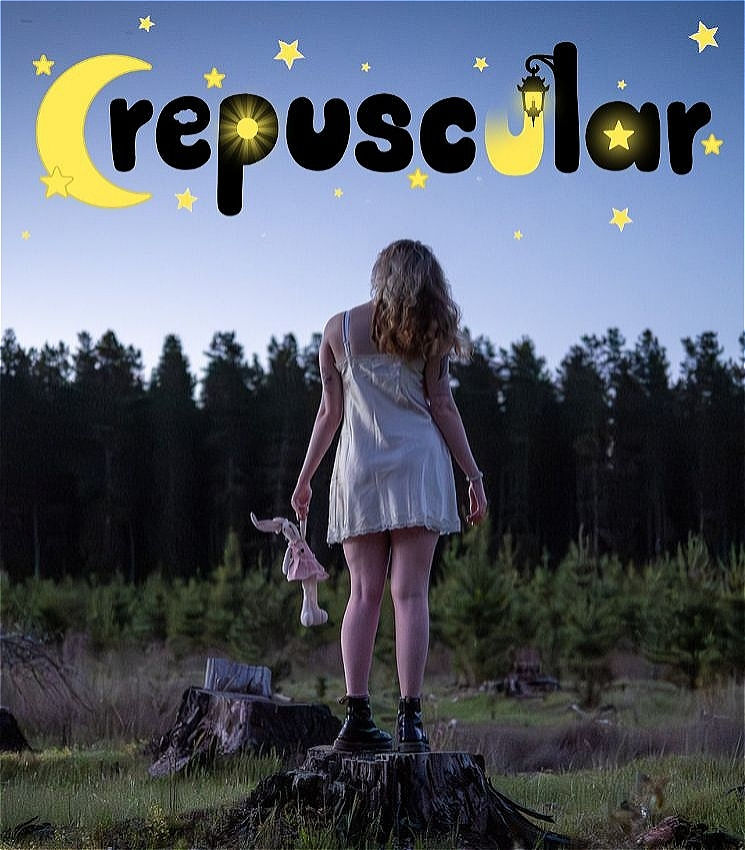
The small space of Motley’s Exchange Room is transformed by a few sheets, a quilted sheet, and a projector (which sometimes also serves as twilight lighting). Amber sits on the small stage in a nightgown, holding a small stuffed rabbit. Above her is the microphone she will come to for songs as well as specific, haunting lines in her story. To her left is a screen, a sheet on a frame, on which, and behind which, words and pictures will land. The room is now somewhere between a little girl’s bedroom, and a fairy’s lecture theatre. It is here that the tale will be told.
I avoid speaking at all about the plot of this woven fairy-tale Amber presents us, but there is a calm pleasure I found myself in, being presented with a quiet tale of minor grief. There is a regrettable desire of artists to engage in trauma pornography, often with the misguided intention to inform or provoke empathy. In stark contrast, Amber’s piece is about a form of tragedy best to simply describe as “growing up”, one that only a few of us have not experienced in some way.
The writing of this production has its own quality of otherness. While primarily written as a fairy-tale, or short story in the vein of Marquez, scattered among its paragraphs are snippets of poetry, or melodic phrases. While the story is broken up by a song on her guitar, the lyrics are integral to the story. These songs often include some sort of unusual looping, including a lullaby and wind chimes. While some of these work better than others in terms of enhancing the song itself, they all add to the strangely mystical quality of the night.
There must be an admission that Crepuscular would not work quite as well if Abbey Amber did not have a small quality of the witch about her. Or, at least, the sort of image of a witch one might evoke if coming from some sort of celtic cultural angle. An Arthurian Morgan, perhaps, stuck too long in rural Australia. It is not so much that she is graceful in movement, as that (at first glance) she appears so. It is not so much that flutes echo her voice, as that they sound in your mind anyway. It’s a reasonable question to ask “would this story work if not performed by the writer”, and I am unsure. It is a strong work, with beautiful writing, but between its personal nature and its individualism of presentation, I am certain at least that it would not work as well.
Crepuscular is a late-night show, far from the hours it refers to. It is also a late-night show, a bedtime story for those of us who have seen enough shows for the night, and want to dream a while about childhood memories and hopeful futures. This is a show I can highly recommend.