Review: A Large Attendance in The Antechamber
Review by Greg Gorton
How do you separate a great thinker’s ideas and “success” from each other? How do we reconcile the implicit impossibility of recreating a person through art? At what point is listening evidence of supporting? And just how well can you make metacomedy work in a cultural time of saturation? These are big questions, and all are faced with intelligence and humour in Brian Lipson’s A Large Attendance in The Antechamber.
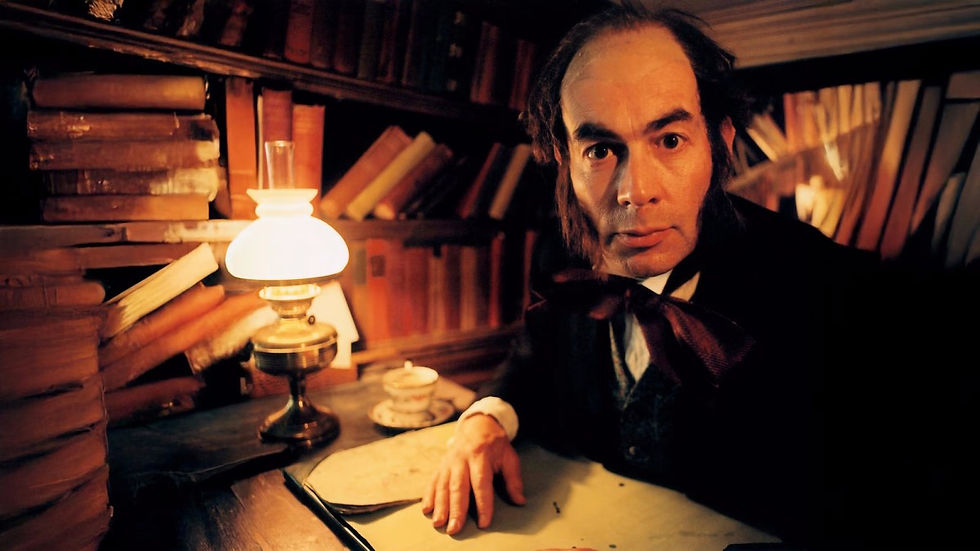
The setting is a small room, enough to barely fit a man in a chair, surrounded by books and scientific paraphernalia. He sits looking out at the audience through a hole in the wall that makes it look a little like a puppet theatre. Renowned scientist Francis Galton knows he is being performed by an actor, and their relationship is far from symbiotic, but he knows a chance to give a good lecture when he sees one.
The production starts off pushing hard on the comedy, with everything from slapstick gags to preposterous puns, Lipson is determined to not only get us in a very good mood, but also get us onside with this “kooky little professor character” who clearly has some odd ideas, but like our old grandfather, seems pretty harmless. As the night progresses, however, some of Galton’s less harmless ideas are put forward, and there are moments of awkward silence as the audience considers how easy it was to like someone before they knew everything. The final half of the show is, while still not without its jokes, a reflection on this betrayal, and this unveiled hypocrisy.
Brian Lipson is an incredible comedic performer, with near-perfect timing, and the willingness to engage in some very silly physical pranks. He is able to quickly build a rapport with the audience, navigate the odd frustration that occurs when you involve us fickle beings, and present a character that is consistent in their contradictions - it is Galton and his fictional actor who have many sides, but they are all played just as true by Lipson himself.
The writing at a micro level is superb, and even though there is an early nod to “this isn’t how nineteenth century scientists really speak”, there is a powerful verisimilitude in the vocabulary and grammar of Galton. Some small fragments of his “lecture” border on the insane ramblings of Becket’s Lucky, while others may very well have been cut from Galton’s own works. The early presentation of a cross between Doc Emmett Brown and Wallace from “Wallace and Gromit” is an endearing one, and I think everyone loves a good Rube Goldberg machine. As Galton “breaks free”, and we see less metacomedy, the true character is well developed in both speech and mannerisms. This is an engaging lecturer, even when talking about rubbish science.
In terms of the narrative writing, and larger attempts at thematic and political throughlines, there are few weaknesses. A second-half story of a quest in Africa offered little in the way of comedy and added nothing to Galton that we hadn’t already quite recently learned. It also, for me at least, prevented me from sitting on the absolutely magnificent moment of a tea break, a moment I will remember from this show well past any other.
There could be other minor quibbles found in this work, if one insisted on doing so. I was unsure if Lipson actually did expect anyone in the post-COVID 21st century to use a handkerchief, and a major inconvenience for the audience in the beginning of the show was not entirely worth its eventual pay-off.
In the theatrical world, you become used to norms and traditions when it comes to applause. Opening nights at MTC take forever and the show always gets a standing ovation. If an audience numbers less than fifty anywhere, a standing ovation is much less likely. And always, or at least almost always, when the lights go on and the doors open people have long stopped clapping and are already halfway to the station. When I say A Large Attendance in The Antechamber is amazing, it may not mean much. So instead I will say that when the lights went on and the doors opened, not a single audience member moved until Lipson was forced back on stage to bow again.